
TMS therapy for Delray Beach — outpatient TRD care, 0 minutes from home.
A specialist outpatient program for clients in Delray Beach. PHP, IOP, in-house psychiatry, sober-living network, family programming. Same admissions team, 24/7.
Start the conversation Or call directly — (561) 421-4107Local options exist. This is the clinical specialist.
RECO Integrated Psychiatry runs its TMS program out of a central Delray Beach office — zero miles from Pineapple Grove, Lake Ida, Tropic Isle, and the Beach District. The clinical model is outpatient psychiatry: prior authorization, motor threshold mapping, and daily 10 Hz or iTBS sessions are handled by the same team, without a facility fee or PHP enrollment. Response is tracked on PHQ-9 at every visit, and Spravato and IV ketamine are on the same clinical menu for clients who do not remit on TMS alone.
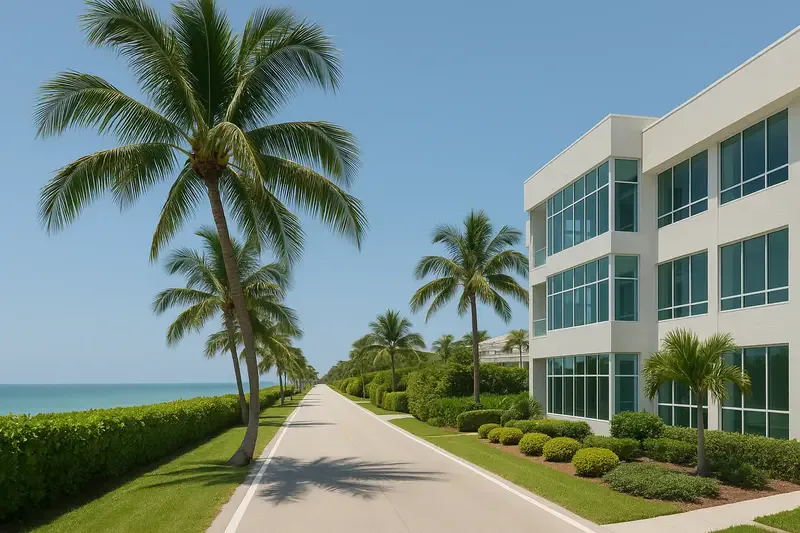
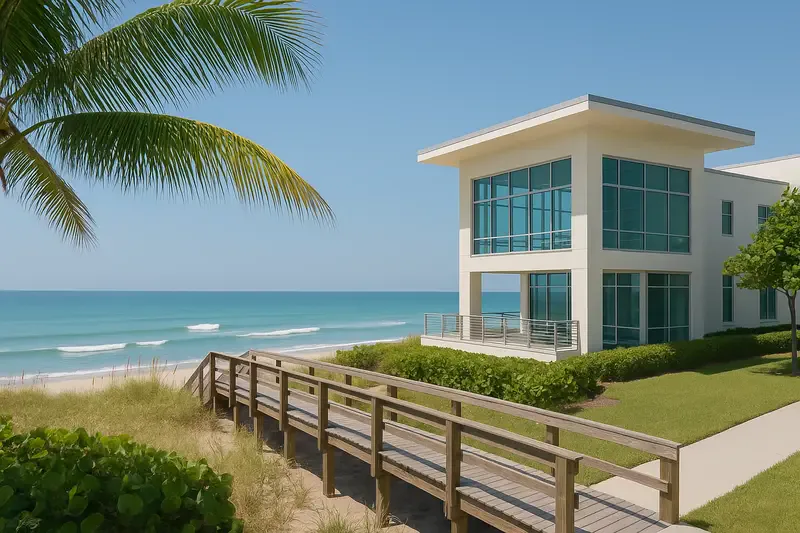
For adults living in Pineapple Grove, Lake Ida, Tropic Isle, Osceola Park, and the Beach District, treatment-resistant depression should not have to be managed around a commute. RECO Integrated Psychiatry runs its TMS therapy program out of a central Delray Beach office — one block off Atlantic Avenue, a short walk from the ocean, and zero miles from home for anyone already inside the city limits. The clinical model is outpatient psychiatry: no PHP enrollment, no IOP schedule, and no facility fee stacked onto the daily protocol.
Insurance-covered TRD candidacy and how we document it
Commercial coverage for repetitive TMS in treatment-resistant major depressive disorder typically requires two documented adequate antidepressant trials at therapeutic dose and duration — sertraline titrated to at least 150 mg for six weeks, venlafaxine XR to 225 mg, escitalopram to 20 mg, or bupropion XL to 300 mg — with adequate adherence, plus a course of psychotherapy. Augmentation trials with aripiprazole 2 to 5 mg, lithium at a therapeutic serum level, or quetiapine XR often count against the same requirement.
RECO’s psychiatry team reviews the entire treatment history at the consult and documents each trial in the format the payer requires. For clients whose care has been scattered across a primary care physician, a former psychiatrist, and a telehealth platform, the reconstruction is part of the intake, not a separate step. PHQ-9 is collected at baseline and at every visit; most commercial payers want a documented score at or above 15 before authorizing the initial course.
Prior authorization is submitted before the motor threshold mapping session, and appeals are handled in-house when the first submission returns a denial. Clients are not asked to hand-carry paperwork between offices.
Motor threshold mapping and the first week
Session one is motor threshold determination — the minimum stimulator output that reliably evokes a visible right-thumb twitch when the coil sits over the left motor cortex. Treatment intensity is then set at 120% of that motor threshold. The stimulation site over the left dorsolateral prefrontal cortex is localized using the Beam F3 method or the 5.5-cm rule; Beam F3 adjusts for individual head measurements and is the default for most protocols.
Sessions two through five acclimate the client to the stimulation. Scalp discomfort under the coil is most pronounced in the first week and typically fades as the periosteum accommodates; a small share of clients need a one-visit intensity ramp before tolerating the full 120% dose. The standard protocol delivers 3000 pulses per session in 10 Hz trains over roughly 37.5 minutes; iTBS delivers 600 pulses in three minutes.
Clients drive themselves to and from treatment, return to work the same day, and are not sedated. There is no post-session monitoring window beyond the treatment itself, and no cognitive dulling that would interfere with the rest of the day.
Standard 10 Hz versus intermittent theta burst (iTBS)
The standard 10 Hz protocol runs 20 to 40 minutes per session depending on the device and the pulse count prescribed. Intermittent theta burst stimulation is an FDA-cleared alternative that delivers equivalent efficacy — the THREE-D non-inferiority trial demonstrated comparable response and remission rates — in a three-minute session. For clients who cannot cleanly schedule a 45-minute daily appointment for six consecutive weeks, iTBS makes the full course feasible without carving out a working day.
Not every commercial plan reimburses iTBS at the same rate as standard 10 Hz, and some carriers still require the longer protocol on first authorization. RECO confirms coverage in writing before the first session is scheduled and does not switch protocols mid-course without payer approval. For deep TMS in obsessive-compulsive disorder, the H7 coil and its longer, higher-frequency protocol is the appropriate platform, and YBOCS is tracked at baseline, mid-course, and completion.
Selection between protocols is a clinical decision, not a scheduling one — but real scheduling constraints are named at intake rather than after authorization.
Response, taper, and the retreatment question
Published response rates for rTMS in treatment-resistant depression run 40 to 60 percent, with remission rates of 25 to 40 percent across large registry datasets. Clinical response — a 50 percent reduction on PHQ-9 or a comparable scale — typically emerges between sessions 15 and 25. Clients who show no measurable movement by session 20 are re-evaluated for coil placement, protocol adjustment, or a different intervention entirely; Spravato and IV ketamine are on the same clinical menu at RECO and are appropriate for a subset of non-responders.
The final six sessions of a standard course are a taper — three per week, then two, then one — rather than an abrupt stop. Post-treatment maintenance is not routinely required for first responders, but PHQ-9 is tracked monthly for the first year, and any medication changes are coordinated so the taper of an augmentation agent such as aripiprazole is not confounded with post-TMS relapse.
Responders who later relapse, commonly six to twelve months post-treatment, are candidates for a second full course. Insurance typically covers retreatment on documentation of prior response and a current relapse meeting the same PHQ-9 threshold. A subset of clients enter maintenance TMS at roughly one session per month; coverage for maintenance is more variable than for acute courses and is confirmed case-by-case.
What to expect on the first visit
The intake is a full psychiatric evaluation, not a TMS screening. A RECO psychiatrist reviews presenting symptoms, longitudinal course, prior medication and psychotherapy trials, current medications, family psychiatric history, medical comorbidities, and substance use. PHQ-9 and GAD-7 are administered at the visit; ASRS is added when attention symptoms are on the differential, YBOCS when obsessive-compulsive symptoms are prominent, and a brief trauma screen when EMDR or trauma-focused CBT might be indicated alongside biological treatment.
The TMS safety screen is specific: no ferromagnetic implants above the neck, no cochlear implant, no cardiac device in the stimulation field, no history of unprovoked seizure, and no medications that meaningfully lower seizure threshold at high dose without a taper plan. Pregnancy is not an absolute contraindication but is discussed on the record.
If TMS is the right fit, the prior authorization submission and the motor threshold session are scheduled before the client leaves. If the clinical picture points elsewhere — a medication optimization first, a Spravato induction, or a CBT or ACT course for symptoms driving the depression — that plan is written and the client is not steered into TMS to fill a chair.
Insurance and getting to the office from Delray Beach
RECO Integrated Psychiatry is in-network with Florida Blue, Aetna, Cigna, UnitedHealthcare, Humana, and Blue Cross Blue Shield. Verification of benefits and prior authorization are handled in-house before the first paid session, and self-pay pricing is published without a facility fee.
The office is one block off Atlantic Avenue in central Delray Beach. Drive time from Pineapple Grove or Lake Ida is under five minutes; from Tropic Isle, Osceola Park, or the Beach District, under ten. Because the standard daily protocol requires 30 consecutive weekday sessions, most Delray Beach clients keep working through treatment and slot the appointment against a lunch break or before an office start time.
Serving residents of: Pineapple Grove, Lake Ida, Tropic Isle, Beach District, Osceola Park.
If it's any of these, we can help.
From Delray Beach callers, most asked.
Which insurance plans cover TMS therapy at RECO's Delray Beach office?
How long does a full course of TMS take from the first Delray Beach appointment?
What happens at the first visit if I am being evaluated for TMS?
How does transcranial magnetic stimulation actually work for depression?
How do I get to RECO Integrated Psychiatry's office from other parts of Delray Beach?
Can family members be involved in treatment, and what happens to my privacy at work?
Other delray beach-area communities we serve.
Confidential. No commitment.
Tell us a little and a real human from admissions will call you back. We verify insurance benefits within minutes and tell you honestly whether RECO Integrated Psychiatry is the right fit — including if we should refer you elsewhere.