Top 6 OCD Recovery Tools for Delray Beach Families 2026
If you are reading this because OCD has started to run your home, take a breath. That knot in your stomach makes sense. Families in Delray Beach often tell us the same thing: the fear is not just the symptoms, it is the way those symptoms spread into everyone’s day. A missed school drop-off, a […]
If you are reading this because OCD has started to run your home, take a breath. That knot in your stomach makes sense. Families in Delray Beach often tell us the same thing: the fear is not just the symptoms, it is the way those symptoms spread into everyone’s day. A missed school drop-off, a long evening on Atlantic Avenue, or a quiet house near the beach can all become triggers.
-
The relapse prevention kit families wish they had before OCD starts running the house
Why intrusive thoughts feel louder at home in Delray Beach and how families accidentally feed the cycle
Intrusive thoughts often feel louder at home because home is where habits form fastest. When stress rises, the brain starts scanning for danger, and OCD latches onto that alarm system. In a coastal town like Delray Beach, where family schedules can shift around work, school, sports, and travel, routines may get loose. That is exactly when OCD can push harder.
Families often try to calm things by giving repeated reassurance. They answer the same question ten times. They check locks, texts, or medication bottles. It feels caring, but it can quietly train OCD to return louder. Here is the part most families miss: reassurance may lower anxiety for a moment, yet it strengthens the doubt cycle over time. That pattern shows up in OCD treatment for families in Delray Beach.
The family accommodation traps that look helpful but keep compulsions alive
Accommodation is any move that helps OCD avoid discomfort. It can look small. A parent rewrites an email. A partner throws away food after a contamination fear. A sibling changes the route home to avoid a feared place. These acts may seem kind, but they can become part of the ritual.
“I have to thank reco for saving my life. I was on a long downward spiral and just couldn’t stop. I was mentally, emotionally, spiritually, and physically exhausted. Reco is hands down the best treatment center for treatment and therapy/mental health i have been to. I am eternally grateful to reco for giving me a solid start on my recovery journey.”- David B., a 5 star review from RECO Integrated Psychiatry on Google Business Reviews
One family we met in Palm Beach County kept moving dinner plates six inches apart because one teen said the spacing felt “safer.” Nobody wanted conflict, so the rule stayed. Within weeks, the rule spread to cups, utensils, and then the fridge. That is how OCD expands. The goal is not to be harsh. The goal is to reduce accommodation slowly, with a plan and clear support.
Which coping tools belong in the house right now, including grounding techniques and sleep hygiene for anxiety
Your house needs tools that lower arousal without feeding compulsions. Grounding techniques help the body settle when the mind races. Sleep hygiene matters because poor sleep raises anxiety and reduces self-control. That combination can make OCD rituals stickier the next day.
A practical home kit may include:
- A written response script for repeated reassurance requests
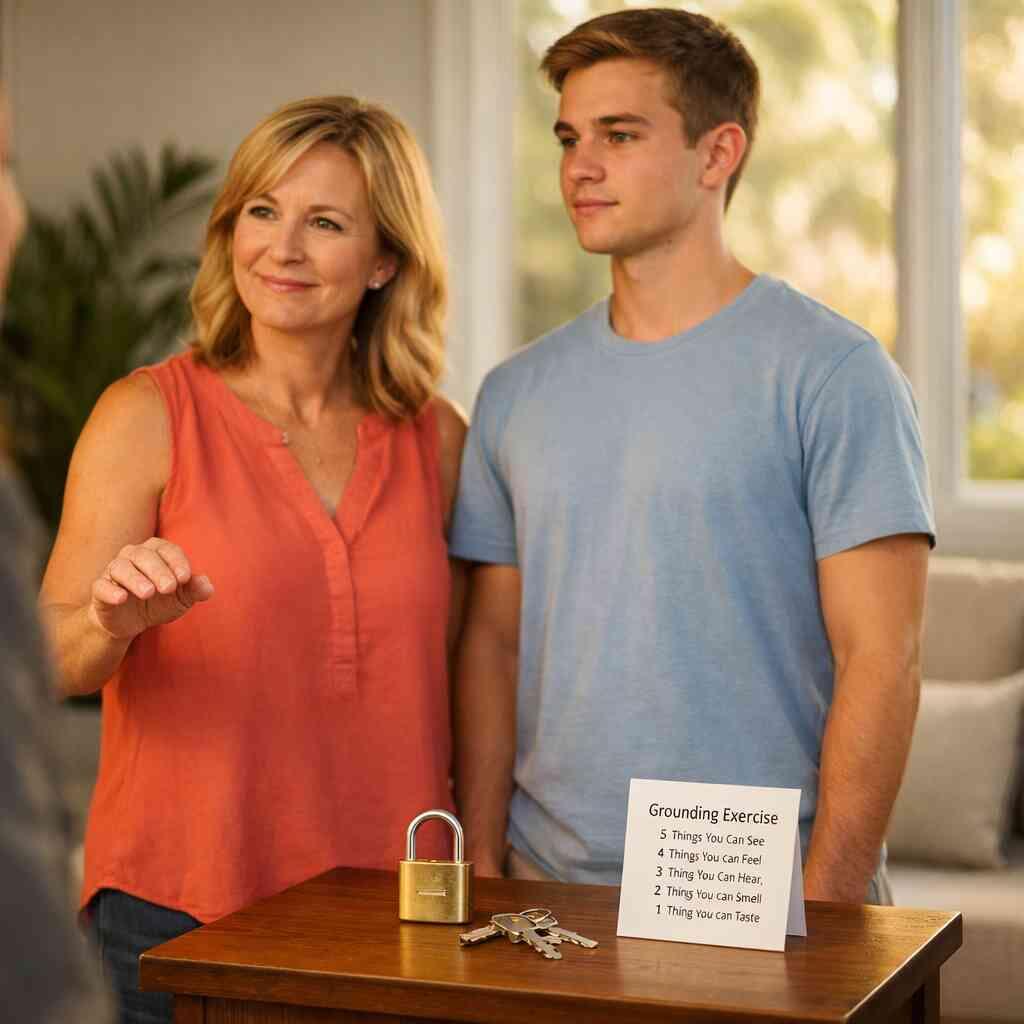
- A 5-4-3-2-1 grounding card
- A short breathing exercise used once, not twenty times
- A bedtime routine with lights dimmed and screens off
- A family agreement about not debating the obsession
A Delray Beach parent once told us her son’s worst evenings happened after late soccer practice and a rushed dinner. His thoughts spiked, then the checking started. Once they fixed bedtime timing and removed one reassurance habit, the house felt calmer within weeks. Small shifts matter. Consistency matters more.
-
Exposure and response prevention for OCD when the whole family is involved
What ERP therapy for OCD actually looks like in outpatient mental health care
Exposure and response prevention, or ERP, is the most studied behavioral treatment for OCD. It means facing feared thoughts, images, or situations in a planned way, then resisting the ritual that usually follows. The work is uncomfortable, but it is also precise. Good ERP never means throwing someone into fear without preparation.
In outpatient mental health care, ERP starts with a hierarchy. You and your clinician rank triggers from easier to harder. Then you practice exposures in small steps. For example, someone with contamination fears may touch a “safe” object and wait before washing. Someone with checking rituals may leave the house after one lock check.
Families often ask if ERP is just “flooding.” It is not. It is skill-based and paced. It works best alongside exposure and response prevention for OCD in South Florida, especially when the therapist knows how to coach the whole household.
How parents and partners support exposures without becoming reassurance machines
Support is not the same as rescue. During ERP, your job is to help the person stay with discomfort long enough for the brain to learn something new. That can mean offering encouragement, not answers. It can mean saying, “I know this feels awful, and I believe you can sit with it.”
Parents and partners should also watch their own reflex to smooth everything over. If your child asks, “Are you sure I am not contaminated?” the best answer may be calm and brief. Repeating long explanations usually keeps the loop alive. The same rule applies to partners who get pulled into checking, confessions, or repeated promises.
A few useful phrases:
- “I can see you are anxious.”
- “Let’s use the plan.”
- “I am not going to answer that again.”
- “You can do hard things in small steps.”
That kind of support is often easier after family-centered OCD care in Delray Beach has taught everyone the rules of the game.
When family therapy for OCD makes progress faster and when it needs to be paired with individual care
Family therapy helps most when accommodation is high, conflict is rising, or everyone feels confused. It gives the household a shared language. It also lowers blame, which matters because shame makes OCD harder to treat. The work is especially helpful when parents disagree on how strict to be.
Still, family therapy is not enough by itself for many people. If the person with OCD has severe rituals, panic, depression, trauma, or suicidal thoughts, individual care must run alongside family work. That combination often improves follow-through. It also gives room for private fears that are hard to speak aloud in a group setting.
On the treatment plans we see most often, the strongest results come when family therapy and individual ERP move together. That pairing fits well with outpatient mental health care in Delray Beach, especially when daily life still needs to continue.
-
The cognitive behavioral therapy moves that quiet obsessive doubt without feeding rituals
How cognitive restructuring helps challenge distorted threat signals
Cognitive behavioral therapy, or CBT, helps you test thoughts instead of obeying them. In OCD, the brain sends threat signals that feel urgent and true. Cognitive restructuring asks a simple question: “What is the evidence, and what is the story OCD is telling?”
This is not positive thinking. It is more disciplined than that. You learn to spot all-or-nothing thinking, inflated responsibility, and catastrophic prediction. Then you replace those distortions with something more accurate. For example, “If I do not check again, something terrible will happen” becomes “I feel danger, but feeling danger is not proof.”
We often point families toward evidence-based CBT for OCD recovery in Delray Beach because it gives structure to thoughts that otherwise spiral all day. That structure helps in school, at work, and at home.
Behavioral activation and routine building when OCD and depression overlap
OCD and depression often feed each other. OCD steals time and energy. Depression then lowers motivation, which makes rituals feel easier than action. Behavioral activation breaks that loop by putting meaningful activity back on the calendar before mood improves.
Start small. Pick one morning routine, one movement break, and one connected activity each day. Use simple anchors: shower, breakfast, walk, call, task, rest. This matters because OCD thrives in empty, unstructured time. Routine gives the brain less room to ruminate.
A young adult in Boca Raton once described her afternoons as “a blank wall.” She checked messages, then checked again, then froze. We helped her build a routine around lunch, a ten-minute walk, and one work block before any phone scrolling. The rituals did not vanish overnight. But the day became livable again.
Why trauma-informed OCD treatment often needs EMDR trauma therapy or PTSD treatment support
Sometimes OCD sits next to trauma. Sometimes it grows from trauma. Sometimes both are true. In those cases, trying to treat only the rituals can leave the deeper alarm system untouched. Trauma-informed care helps clinicians notice what is driving the fear.
EMDR trauma therapy can be useful when traumatic memories keep activating obsessive doubt or body panic. PTSD treatment support may also be needed if nightmares, hypervigilance, or flashbacks are part of the picture. This is why dual diagnosis treatment matters. The brain is not splitting problems into neat boxes. It is dealing with a cluster.
That is also why experienced teams look at how RECO Integrated Psychiatry treats anxiety and OCD together. When anxiety and OCD overlap, the plan has to respect both.
-
When medication management for OCD becomes the missing tool, not the whole plan
Which symptoms point to a psychiatric evaluation in Delray Beach and a medication review
A psychiatric evaluation makes sense when OCD is taking too much time, sleep is slipping, or work and school start to suffer. It also matters when panic, depression, or irritability are growing alongside the rituals. Families in South Florida often wait too long because they hope symptoms will settle on their own. Sometimes they do not. A medication review can help if: 
- Obsessions dominate most of the day
- Compulsions take more than an hour daily
- Sleep, appetite, or concentration decline
- Therapy alone is not enough
- Depression or anxiety adds more weight
That review may happen in person or through telepsychiatry in Florida, which can help when travel or schedules make office visits hard.
How selective serotonin reuptake inhibitors and augmentation fit into evidence-based OCD treatment
Selective serotonin reuptake inhibitor medication, often called an SSRI, is commonly used for OCD. Research supports SSRIs as part of evidence-based OCD treatment, especially when paired with ERP or CBT. Some people need higher doses than those used for depression, but only a clinician should guide that decision. If symptoms remain severe, augmentation may be considered.
Augmentation means adding another medication strategy when the first plan helps but does not go far enough. This is not about chasing a miracle fix. It is about adjusting treatment carefully. For some patients, SSRIs may be part of a broader plan that includes family work, therapy, and follow-up.
Families sometimes ask about FDA-approved options used in related psychiatric care, like Vivitrol or Suboxone, because they hear about medication-assisted treatment in other settings. Those are not OCD medications, but the question is reasonable. It shows you are thinking clearly about how medicine supports recovery without replacing it.
What families should ask about side effects, adherence, and medication management for OCD in outpatient care
Side effects matter because people stop medicine when they feel unheard. Ask what changes are common, what is urgent, and how long benefits usually take to show. Ask how adherence will be supported if the person forgets doses or feels uneasy taking them. The answer should be practical, not vague.
Good medication management for OCD in outpatient care also includes coordination with therapy. Medicine works best when it lowers the noise enough for skills to stick. It does not replace the work. It supports the work.
If you want a place to start, ask about medication management for OCD in outpatient care and how it fits with therapy, family input, and follow-up. That conversation can be simple and honest.
-
The support system that keeps recovery moving after the worst flare passes
How support groups for OCD and psychoeducation for families reduce shame and isolation
Shame makes OCD feel secret and heavy. Support groups break that secrecy. When people hear their thoughts named out loud by others, the fear often loses some of its grip. Families benefit too, because psychoeducation explains why “just stop” never works.
Support groups for OCD in South Florida can also help with practical ideas. People share how they handled school pressure, social events, or holiday dinners without feeding rituals. That shared wisdom is powerful. It reminds the family that recovery is a skill set, not a personality test.
For many households, support groups for OCD in South Florida become a steady part of long-term recovery planning. They also reduce the loneliness that often settles in after the first crisis passes.
What relapse prevention strategies look like during school stress, work stress, and holiday stress
Relapse prevention is not waiting until things fall apart again. It means planning for known stress points. School stress can trigger perfectionism. Work stress can trigger checking. Holiday stress can trigger contamination fears, schedule changes, or family conflict.
A strong plan includes:
- Early warning signs
- A short list of coping skills
- A family agreement about reassurance limits
- A backup therapy appointment
- A sleep and meal plan during busy weeks
One Delray Beach family built a “stress map” before the winter holidays. They marked dinner events, travel days, and church gatherings, then planned exposures in advance. That cut down on panic. It also reduced the number of emergency calls. Simple planning can prevent a lot of pain.
Why aftercare support and telepsychiatry in Florida matter for long-term recovery planning
OCD often improves, then flares again under stress. That does not mean treatment failed. It means the brain needs follow-up and refreshers. Aftercare support keeps skills from fading when life gets busy.
Telepsychiatry in Florida helps because it removes distance barriers. If a person is juggling school, work, or family duties, virtual check-ins can keep momentum going. That matters for long-term recovery, especially in a coastal community where traffic, schedules, and weather can all interfere with in-person care.
When aftercare is built well, families stay connected to a plan instead of waiting for a crisis. family support resources for OCD recovery can help reinforce that plan between visits.
-
The Delray Beach roadmap for getting help before OCD steals another season
How to choose between outpatient mental health care, mental health IOP, and partial hospitalization support
Choosing the right level of care can feel confusing. Outpatient mental health care fits people who can function day to day, even if symptoms are serious. Mental health IOP adds more structure, more therapy hours, and more support. Partial hospitalization support is a higher level still, often used when symptoms are intense but inpatient care is not needed.
A simple comparison helps:
Level of careBest forTime structureOutpatient careModerate symptoms, steady functionWeekly or scheduled visitsMental health IOPMore severe symptoms, more support neededSeveral sessions per weekPartial hospitalizationHigh symptom load, close monitoring neededMost of the day, several days weeklyIf you are comparing programs, this breakdown can help clarify the difference between PHP and IOP in Delray Beach. The right fit depends on safety, impairment, and support at home.
What insurance verification, self-pay options, and private psychiatry in Delray Beach actually mean for families
Insurance questions can make people freeze. That is normal. Families want clear answers before they call. They want to know what is covered, what needs approval, and what happens if they are out of network. Those are fair questions.
Insurance verification tells you what your plan may cover before you start. Self-pay options may help if you want more privacy, more flexibility, or if your plan is limited. Private psychiatry in Delray Beach often means more direct scheduling and more individualized follow-up. It does not mean automatic better care. It means a different structure.
If cost is part of your decision, ask about insurance verification for mental health early. A clear answer now can prevent stress later.
When to call RECO Integrated Psychiatry for family-centered OCD care in South Florida and what the intake process feels like
Call when OCD is taking more time than you can spare, or when family life is shrinking around it. Call when reassurance is becoming the main household language. Call when you suspect anxiety, depression, trauma, and compulsions are tangled together. A private, integrated clinic can help sort that out without judgment.
At RECO Integrated Psychiatry, the intake process is built to feel clear and respectful. You speak with a clinician about symptoms, history, family stress, and current safety needs. Then the team helps match you to outpatient psychiatry, therapy, or a higher level of care when needed. The setting is Delray Beach, close to the coastal recovery community and easy to connect with across South Florida.
If you are ready to talk, start with a conversation about family-centered OCD care in Delray Beach. You do not have to solve everything today. Start with one call, one honest conversation, and one plan you can actually follow.
Frequently Asked Questions
How long does detox last at a Delray Beach rehab?
OCD care usually does not require detox, but families often ask because they are comparing treatment options. Detox applies more to alcohol or drug withdrawal. If OCD is paired with substance use, a detox timeline depends on the substance, health history, and medical risk. A clinician can help you sort out whether South Florida detox referral support is needed before psychiatric care starts.
Does RECO Integrated Psychiatry take my insurance?
Insurance coverage depends on your specific plan, benefits, and network status. The safest move is to complete verification before scheduling. That gives you a clearer picture of copays, deductibles, and any out-of-network benefits. If needed, self-pay options may also be discussed during intake.
What is the difference between PHP and IOP?
PHP, or partial hospitalization, provides more hours of treatment and more structure. IOP, or intensive outpatient, offers strong support with more flexibility for work, school, or family duties. PHP is usually for more severe symptoms. IOP is often used when a person needs more than weekly therapy but less than full-day care.
Can family be involved in treatment?
Yes. Family involvement often helps, especially when accommodation has become part of the OCD cycle. Family sessions can teach support skills, reduce reassurance patterns, and improve communication. In many cases, family care works best alongside individual therapy.
What if I need help for depression but not addiction?
That is completely appropriate to bring up. RECO Integrated Psychiatry treats depression, anxiety disorders, OCD, bipolar disorder, ADHD, and complex psychiatric conditions. If you need support for mood symptoms without substance treatment, a psychiatric evaluation can help match care to your needs.
Can I use telepsychiatry if I live in Florida?
Yes, telepsychiatry can be a good option for Florida residents who need flexibility. It may be especially useful for follow-up visits, medication management, or ongoing therapy coordination. It is not right for every situation, but it can make treatment easier to maintain.
Do you only help people with severe OCD?
No. Some people need intensive care, while others need a focused evaluation, therapy, and medication support. The right level depends on how much OCD disrupts your life. If symptoms are getting in the way of sleep, work, school, or family life, it is reasonable to ask for help now.