
Best 7 CBT Skills for OCD Recovery at RECO Integrated Psychiatry
If you are reading this because your mind will not stop looping, take a breath. The fear feels loud, and the doubt feels personal. That is exactly why OCD can be so exhausting. At RECO Integrated Psychiatry in Delray Beach, we work with people who are tired of checking, counting, cleaning, reassuring themselves, and still […]
If you are reading this because your mind will not stop looping, take a breath. The fear feels loud, and the doubt feels personal. That is exactly why OCD can be so exhausting. At RECO Integrated Psychiatry in Delray Beach, we work with people who are tired of checking, counting, cleaning, reassuring themselves, and still not feeling safe. The goal is not to erase every thought. The goal is to teach your brain a different response.
-
The obsession feels real even when the danger is not
Why intrusive thoughts keep firing the alarm system in OCD recovery
Intrusive thoughts are unwanted mental events. They can feel shocking, cruel, or absurd. In OCD, the brain treats them like emergencies anyway. That alarm response keeps the cycle alive. You may know the thought is irrational, yet your body still reacts with panic. That mismatch is one reason OCD feels so convincing.
At our CBT skills for OCD recovery in Delray Beach visits, people often say, “I know this makes no sense, but it still scares me.” That sentence matters. It shows insight and distress at the same time. The problem is not that you are weak. The problem is that the brain keeps tagging a thought as danger. Once that happens, your attention locks onto it.
How compulsions grow from short relief into long-term entrapment
Compulsions work because they lower anxiety quickly. That short relief teaches the brain that the ritual helped. So the next intrusive thought arrives with more force. Then checking, apologizing, googling, confessing, or repeating becomes harder to resist. What starts as a quick fix becomes a prison.
One young adult from the Boca Raton area described spending forty minutes rewriting the same text message. He was not chasing perfection. He was trying to silence doubt. That is the trap. Compulsions never truly settle the fear, so they keep asking for one more round. Over time, they steal time, energy, and confidence.
What RECO Integrated Psychiatry looks for when OCD overlaps with anxiety treatment Delray Beach or trauma therapy South Florida
Here is the part most people miss: OCD rarely shows up alone. It often sits beside panic, depression, trauma, or perfectionism. That is why anxiety treatment Delray Beach care must look beyond the obvious ritual. If trauma is also active, the brain may react to the intrusive thought like a memory threat, not just a worry.
Our team watches for patterns that suggest co-occurring disorders. That includes sleep loss, avoidance, shame, and constant self-monitoring. The National Institute on Drug Abuse and SAMHSA both support integrated care when symptoms overlap. In practice, that means the plan should address both the obsession and the emotional fuel behind it. It should feel coordinated, not fragmented.
-
Exposure and response prevention is the skill that changes the rules
How ERP therapy helps you face triggers without feeding the compulsion cycle
Exposure and response prevention, or ERP, is the core behavioral method for OCD. You meet the trigger on purpose, then you do not perform the ritual. That sounds simple. It is not easy. Still, it is how the brain learns that anxiety can rise and fall without compulsions.
If you want a deeper look at this process, our article on OCD recovery strategies with exposure and response prevention explains the structure in plain language. ERP works because it breaks the old rule: “I must fix this feeling now.” Instead, you learn to stay present long enough for the fear to lose its grip. That learning only happens through repetition.
What makes exposures safe enough to work but uncomfortable enough to teach your brain
Good exposures are planned, not random. They should be uncomfortable, but not overwhelming. If they are too easy, your brain learns nothing. If they are too intense, you may shut down or quit. The right balance is what makes ERP effective.
What we see in 2026 specifically is that people do better when exposures match real life. A parent might practice leaving a door unchecked. A professional might delay a reassurance text. A college student might touch a “dirty” surface and wait before washing. These are not dramatic stunts. They are targeted exercises that teach the nervous system.
Why cognitive behavioral therapy for OCD at an outpatient program Delray Beach depends on repetition, not reassurance
OCD recovery begins with cognitive behavioral therapy for OCD and ERP therapy, but the work only sticks when you repeat it. Reassurance feels kind, yet it often keeps the disorder alive. Repetition builds tolerance. It also builds trust in your own mind.
An outpatient program in Delray Beach for OCD treatment can fit that repetition into real life. That matters if you are working near Atlantic Avenue, caring for kids, or commuting across Palm Beach County. You do not need to pause your whole life. You do need structure, practice, and follow-through.
-
The seven CBT skills that weaken OCD at the source
Spotting obsessional thinking patterns before they turn into ritual loops
The first skill is recognition. You learn to notice obsessional thinking patterns early. That may sound basic, but it changes everything. If you can name the loop, you can interrupt it sooner. Common patterns include catastrophic “what if” questions, mental reviewing, and inflated responsibility.
A client once said her OCD always began with “just a quick check.” That was the clue. The ritual never started with panic. It started with a small permission. When you catch that moment, you gain leverage. You are not fighting the thought yet. You are simply naming the pattern.
Using cognitive restructuring to test fear-based predictions more honestly
Cognitive restructuring helps you test distorted thoughts. It asks, “What is the evidence? What is the actual probability? What would I tell a friend?” This is not positive thinking. It is disciplined thinking. It slows down the mind’s worst assumptions.
Our clinicians often pair this with behavioral experiments and cognitive restructuring for OCD. That pairing matters because thoughts change more when behavior changes too. For example, if you fear leaving a message unread will cause disaster, you test that prediction in real life. Then you observe what actually happens. That evidence weakens the fear more than argument does.
Building uncertainty tolerance when your mind demands perfect certainty
OCD hates uncertainty. It demands guarantees no human can get. So uncertainty tolerance becomes a core recovery skill. You practice saying, “I can live with not knowing.” That sentence may feel terrible at first. That is normal.
If uncertainty also spikes general anxiety, uncertainty tolerance and distress tolerance for OCD are often taught together. The brain learns that discomfort is not danger. That lesson is slow, but it is powerful. Over time, you spend less energy trying to solve the unsolvable.
Practicing distress tolerance for OCD so anxiety can rise and fall without a ritual
Distress tolerance means staying with discomfort without escaping into ritual. You do not have to enjoy it. You only have to outlast the peak. The body’s alarm system rises, then falls. That arc is one of the most important lessons in OCD recovery.
People in South Florida often ask for a fast fix because life is busy. I get that. Still, the nervous system does not rush. It learns through repeated safe contact with discomfort. A skill like paced breathing, grounding, or a brief walk can help you wait without ritualizing. The point is not distraction. The point is non-response.
Using thought defusion and mindfulness for OCD to notice thoughts without obeying them
Thought defusion helps you see a thought as a thought. Not a fact. Not a command. Just a mental event. Mindfulness for OCD trains that same muscle. You notice the thought, label it, and let it pass.
Our guide on mindfulness for OCD and thought defusion skills explores this more fully. Defusion is useful because it creates space. Instead of “I am contaminated,” you practice “I am having the thought that I am contaminated.” That small shift weakens the urgency. It gives you room to choose.
Running behavioral experiments that disprove the rule your OCD keeps repeating
Behavioral experiments test the rule, not just the feeling. If OCD says, “If you do not check, something bad will happen,” the experiment asks you to pause and see. You collect real-world data. Then you compare the prediction with the result. That process is fair, direct, and persuasive.
A patient in the downtown Delray area feared he would lose control if he did not reread emails. He tested that belief with guided practice. The emails still went out. His anxiety dropped on its own. That is the kind of learning OCD cannot argue with for long.
Tracking relapse prevention planning and coping skills for OCD between sessions
Recovery does not stay in the office. It lives in the in-between moments. That is why relapse prevention planning and coping skills for OCD matter so much. You need a plan for poor sleep, holiday stress, family conflict, and unexpected spikes.
That plan should name triggers, early warning signs, and go-to responses. It should also include what not to do. For many people, that means reducing reassurance seeking and delaying rituals. Consistent tracking makes it easier to spot a flare before it grows.
-
When OCD is not the only diagnosis in the room
How dual diagnosis treatment changes the plan when depression and anxiety support are also needed
OCD often drains mood. It can also coexist with depression, panic, or substance use. That is why dual diagnosis treatment for OCD with depression and anxiety support is so important. If you only treat one layer, the others keep pulling on symptoms.
NIDA and SAMHSA both support integrated treatment for co-occurring disorders. That means the care plan should reflect the full picture. When depression is present, motivation drops. When anxiety is high, exposure work feels harder. Good treatment adjusts for both.
Why PTSD treatment and EMDR trauma therapy may matter when OCD is tied to trauma
Sometimes OCD and trauma feed each other. A trigger may not just feel scary. It may feel loaded, personal, or old. In those cases, PTSD treatment in South Florida when trauma and OCD overlap may be part of the plan. EMDR can also help when memories keep the nervous system on alert. 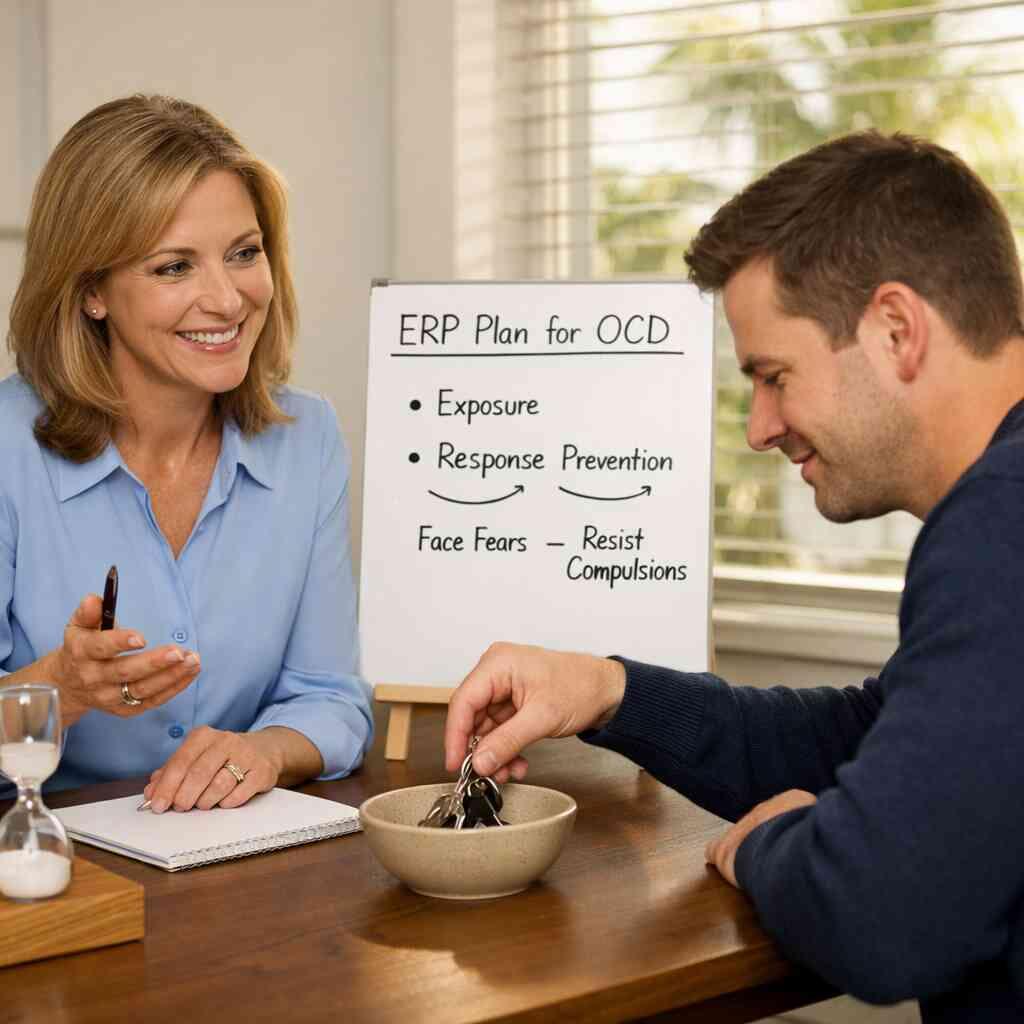
That does not mean trauma work replaces ERP. It means the treatment team should know what is driving the fear. If the body is reacting to trauma, the exposure plan may need to move more carefully. For some people, that coordination is what makes CBT skills finally usable.
When medication management for OCD and medication management in psychiatry should work beside CBT skills
Medication does not teach exposure skills. Still, it can lower symptom intensity enough for the skills to stick. Medication management for OCD with licensed clinicians is often part of a balanced plan. That may include careful monitoring, dose adjustments, or side-effect review.
Selective serotonin reuptake inhibitors are commonly used for OCD, and some patients need more than one layer of support. The key is coordination. Medication should support ERP and CBT, not replace them. When symptoms are severe, that combination can make practice feel possible again.
How licensed clinicians coordinate care through mental health IOP and telepsychiatry Florida options
When symptoms are sticky, a weekly visit may not be enough. A mental health IOP in Delray Beach for OCD recovery gives more repetition and more accountability. It also gives you more eyes on progress. That matters when the ritual pattern is changing.
For people who need flexibility, telepsychiatry in Florida for ongoing OCD care can keep treatment moving. That is helpful for South Florida residents balancing work, school, or family. Care can stay connected even when life gets crowded.
-
What treatment can look like in Delray Beach without making life stop
How an outpatient program Delray Beach can fit work, school, and family life
Many people assume OCD treatment means stepping away from normal life. Often, it does not. An outpatient program Delray Beach can fit around work, school, and family responsibilities. That matters in a place like Delray Beach, where routines often include commuting, caregiving, and trying to keep the rest of life moving.
The advantage of outpatient care is practice in real time. You go back to the same kitchen, car, and office that trigger the loop. That is useful. The work becomes practical, not theoretical. You learn skills where the problem actually lives.
When partial hospitalization program care makes more sense than standard weekly therapy
Some people need more support than outpatient therapy can provide. A partial hospitalization program for higher support in Delray Beach can offer that middle level of care. It gives more structure than weekly sessions and less intensity than inpatient treatment. That can be the right fit when OCD is taking over most of the day.
PHP often helps when symptoms are severe, sleep is poor, or functioning is slipping. It can also help if you have tried therapy before and stalled out. The point is not to label the situation as worse. The point is to match the level of care to the need.
What group therapy, activities, and family therapy support can add to skill practice
Family members often get pulled into OCD patterns without realizing it. They answer repeated questions, help with rituals, or adjust routines to reduce distress. Family therapy support helps everyone see the pattern more clearly. That can reduce conflict and improve follow-through.
Group settings also matter. They normalize the struggle and give you a chance to practice skills with support. For many people, hearing someone else describe the same loop is a relief. It lowers shame. It also makes the work feel less lonely.
How South Florida psychiatry teams use individualized treatment planning and aftercare planning to keep progress moving
Delray Beach mental health care and individualized treatment planning should never feel generic. Your triggers, schedule, and family situation matter. So does your history with anxiety, trauma, or medication. A good plan accounts for all of that. It should also include aftercare planning before discharge or step-down.
The most stable gains often come from simple planning. People know what to do when symptoms return. They know who to call. They know which skills work best at home, in traffic, or after a hard night. That kind of planning protects progress.
-
The details that make the skills stick after the session ends
Why homework practice matters more than insight alone in OCD recovery strategies
Insight is useful. Practice is stronger. You can understand OCD perfectly and still keep ritualizing if you do not rehearse new behavior. That is why homework matters so much in OCD recovery. It turns ideas into habits.
Between sessions, you may write down triggers, track urges, or complete exposure exercises. That work can feel tedious. Still, it is where change compounds. The brain needs repetition more than explanation.
How case management, life skills training, and holistic recovery supports reduce stress that fuels compulsions
Stress makes OCD louder. Poor sleep, chaotic schedules, and financial strain all feed the cycle. That is where case management and life skills training help. They reduce the daily pressure that keeps the nervous system on edge. Holistic recovery can also help when it is used in a grounded way.
At RECO, that may include nutrition support, movement, mindfulness, or other stabilizing routines. These are not cures. They are supports. When your baseline stress drops, your response to intrusive thoughts often improves too.
Where support groups, SMART Recovery, and 12-step alternatives can fit for co-occurring disorders and substance use
Some people with OCD also struggle with alcohol or drug use. In those cases, support for co-occurring disorders must account for both conditions. SMART Recovery and 12-step alternatives can both be helpful, depending on your fit. The best choice is the one you can use honestly and consistently.
A few patients worry that a support group will judge them for not doing recovery “right.” That fear is common. Good groups should lower shame, not add to it. The right setting helps you stay connected when symptoms flare.
How sober living resources and alumni program style support can protect long-term recovery when symptoms flare
OCD can flare during transitions. So can anxiety and depression. That is why sober living resources, step-down support, and alumni-style connection can matter. They keep structure in place when life gets less supervised. They also remind you of the skills you already know.
If substance use is part of the picture, continuing care becomes even more important. Support after formal treatment is not extra. It is part of the plan. That is one reason our alumni support and aftercare planning approach stays connected to real-world stress.
-
What to do next when you are ready for relief, not more looping
How to decide whether you need CBT skills for OCD or a higher level of care such as PHP or IOP
If OCD is taking up more than an hour a day, affecting work, or straining relationships, treatment is worth a serious look. If symptoms feel unsafe, constant, or impossible to manage, PHP or IOP may fit better than weekly therapy. The decision is not about toughness. It is about matching support to severity.
A simple rule helps. If you can practice skills between sessions, outpatient may be enough. If the symptoms keep overpowering you, higher structure may help. That is exactly what our team clarifies during assessment.
What the intake process at RECO Integrated Psychiatry can clarify about insurance verification, self-pay options, and medication management
The intake process should reduce confusion, not add to it. At RECO Integrated Psychiatry, intake can help clarify fit, scheduling, and the role of medication. It can also help with insurance verification and self-pay options. Many people want that information before they commit.
If you are worried about cost, ask directly. If you are unsure about medication history, bring it in. If you have tried therapy before, describe what helped and what did not. Clear information makes better planning possible.
How to use Delray Beach recovery community resources and RECO Integrated Psychiatry telepsychiatry Florida care to keep treatment moving forward
Delray Beach has a strong recovery community, and that local support can make a difference. It helps to know what is nearby, what is realistic, and what fits your schedule. Beachside walks, quiet preserves, and routine community support can all become part of a steadier life. The setting matters more than people think.
If you are ready to get specific, start with one call. Ask what level of care fits your symptoms. Ask how telepsychiatry in Florida can support follow-through if driving or scheduling is hard. You do not have to figure this out alone, and you do not have to solve everything today.
Frequently Asked Questions
How long does OCD treatment usually take?
It varies. Some people need a few months of structured CBT and ERP. Others need longer, especially if trauma, depression, or substance use is also present. Progress depends on symptom severity, consistency with practice, and whether the treatment plan fits your daily life.
Does RECO Integrated Psychiatry treat OCD with medication and therapy together?
Yes, when appropriate. OCD often improves best when CBT skills, ERP, and medication management work together. Our licensed clinicians can help determine whether medication support belongs in your plan and how it should coordinate with therapy.
What is the difference between PHP and IOP for OCD?
PHP, or partial hospitalization, gives more hours and structure each week. IOP, or intensive outpatient, is less time-intensive but still more supportive than standard weekly therapy. PHP can fit severe symptoms. IOP can fit strong outpatient needs with more flexibility.
Can telepsychiatry help with OCD care in Florida?
Yes. Telepsychiatry can support medication follow-up, skill coaching, and ongoing check-ins for Florida residents. It works best when you can still practice exposures and CBT homework in daily life. It is often useful for maintaining momentum between in-person visits.
Is family involved in OCD treatment?
Often, yes. Family members may unknowingly support compulsions, so family therapy can help everyone respond differently. It can also reduce conflict and improve communication. That support is especially useful when home routines have been shaped by OCD for a long time.
What should I bring up during intake?
Bring up your main symptoms, any past therapy, medications, sleep issues, trauma history if relevant, and any substance use concerns. Also mention what you hope treatment will change. Clear details help the team build a plan that is practical and realistic.
Could OCD be related to trauma or depression?
Yes. OCD can overlap with trauma, depression, and anxiety. That is why integrated assessment matters. If trauma symptoms are part of the picture, EMDR or PTSD-focused care may be considered alongside OCD treatment. The plan should reflect the whole person, not just one diagnosis.
*”I had a wonderful, powerful, exceptional experience in recovery at RECO Integrated psychiatry/intensive,as well as all around mental,emotional and addictive therapy. The staff is wonderful , it is a safe space clean and modern . The exercises in mental health therapy was an amazing opportunity and full whole person addiction mental, physically and emotionally treatment. Very structured program, each day has a specific direction that follows a wonderful whole person treatment plan. Great therapist,peer to peer work as well . I enjoyed one on one and group sessions. I personally took part in PHP,IOP and they offer OP as well . The facility took us to meetings and groups almost every night except the day(s) they brought the meeting to the sober house I stayed in. We had outings and activities every week , equine therapy too. I can’t say enough about this facility,program and staff . I would recommend to anyone any age to consider RECO for a complete and thorough treatment facility. I have remained sober after coming home ,I am regaining confidence, lost relationships and a sober community since treatment . RECO gave me skills and realized dreams to stay clean and sober .”- A.LeeGNV, a 5 star review from RECO Integrated Psychiatry on Google Business Reviews
Schema note: FAQPage JSON-LD should mirror these questions and answers for search engines.